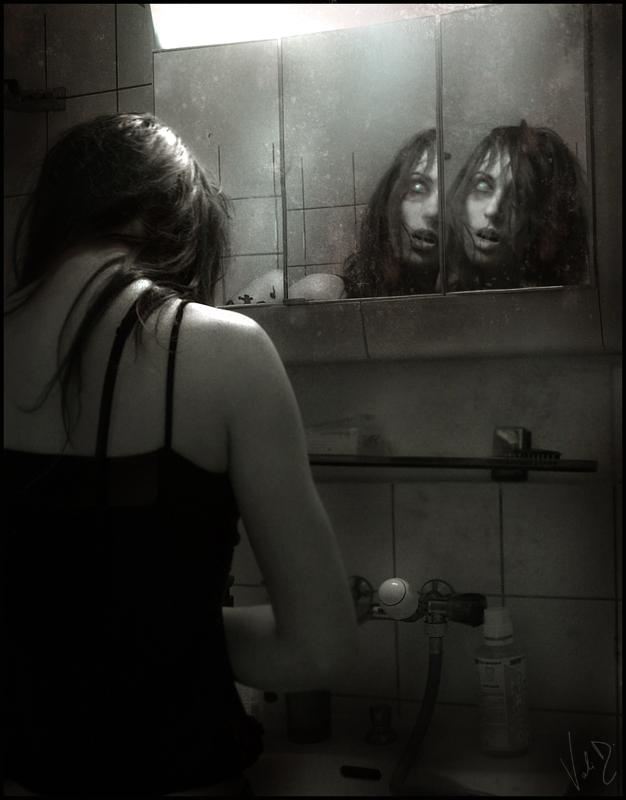
This new production by Nicolas Winding Refn has resemblance to that of Black Swan. As he stated "One morning I woke up and realised I was both surrounded and dominated by women. Strangely, a sudden urge was planted in me to make a horror film about vicious beauty."
We took inspiration from the framing in these long shots, where the protagonist is positioned in the centre of the frame surrounded by symmetrical mis en scene and locations on either side, the use of symmetry makes the scene lose its qualities to catch the attention, instead having the audience focus their attention on main character who is isolated in the centre of the frame.
The use of mirrors is another symbol and motif of duality within a person especially in an over the shoulder shot or a close up, demonstrating alter ego's perceived on either side of the pane of glass. We use this especially within our sequence as in both the public and private bathroom, where her reflection of herself spurs the flashbacks to her eventual inevitable realisation of her alter ego.
The representation of the darker alter ego, is especially representational in the darkness surrounding them especially within lighting such as in the flashback of the bedroom where she is immersed in the darkness, since we only used a key light and no back light. The dark colours even of the costumes and makeup especially in the bottom of the three pictures, with the dark eye and lips to outwardly depict the darkness of the persona. This is the atypical rebellious character, depicted in more hollywood productions likely as promiscuous.
Juxtaposing this, you have the use of white light and high key lighting with the more passive persona, surrounded by reflective objects. This is the atypical fragile "girl next door" character who is timid and vulnerable hunted by the darkness of her thoughts. The lack of intense makeup combined with the paler clothing complimenting her skin tone, produces an angelic quality.
We further used the domesticated settings of bedrooms and bathrooms as they do here, despite the above location depicting a hotel room, we use a similar concept of the public facilities evident in the bathroom, where she attempts to find refuge yet cannot, hence is driven home to her own bathroom.
We decided due to the nature of it being a psychological thriller, and the use of a schizophrenic multiple personality main character to take and gather inspiration from Black Swan with the use of mis en scene and camera angles/ framing.
Dance of the White Swan
The high key, key and fill light used here accompanied by the top lighting, within an eye level close up shot, emphasises her innocence and naivety but also accentuates the pure sadness and distraught facial expression. We used a similar shot within the bedroom by the innocent persona, using torches to highlight her expression, but lacked any back light to demonstrate the immense darkness she experiences as a result of her mental health issues.
We additionally, use light as a medium of disorientation or confusion of the innocent persona, as a means to demonstrate the distinct difference between her dark and light personality traits. This is generally a key light, such as the spotlight in Black Swan which is instead a light in the tunnel within our chase scene.
Here the makeup reflects the face of our character within the contrasting bath scene, the eye level close up shot with the shoulders included is parallel to the character within the bath tub. The pale face to highlight her cheekbones, determines her as thin and ill whilst colour on the lip here being red the alternative in ours being black connotes tension and suppressed anxiety.
We use a similar close up eye level shot of our character crying, as a means to demonstrate the depth of sorrow and anxiety they are feeling, in both there is a greater use of back light to contrast the character to the great darkness surrounding them.
Similarly, the use of the pastel colours and lighter colour scheme within her dressing room we imitate further in our bathroom with the stereotypical beige and wood inner decor to contrast greatly to the flashback images of the alter ego.
Odile Appears
These two close ups of the alter ego "Odile"'s eyes demonstrates the inner battle between her sanity and her sanctity, yet here we finally see her relinquish to this demonic part of her mental state, evident in the close up and more extreme close up of her face with focus on her eyes. We took inspiration from this by having a number of close ups of her face within the mirror(s), in the bath tub, and further in her flashbacks, with the flashbacks having white contacts as a contrast.
Despite the dramatic makeup being used in Black Swan being used as stage makeup, we used a similar concept as a means of contrasting with the two aspects of her personality. The extremely dark and more manic eye makeup is used on the darker aspects of her personality, as a visual representation of her alternative personas. Even with the more passive and innocent character, we use shots where she attempts to rub off this enhanced eye makeup, to reveal and free herself from this part of her soul.
The Bedroom
The most iconic part of this scene is the use of mirrors as a symbol of duality within a person to demonstrate the two distinctive alternative personalities found in one body. We thus used this in the more intense and industrial toilet setting, but again also in the more domesticated bathroom in her house. The two bathrooms also providing a clear contrast from each other, being an extended metaphor of her two personalities within the surrounding setting. The cold, lifeless public toilet in contrast to the cosy, homely bathroom.
The extreme close ups of the scratches and injuries as an outward representation of her transforming schizophrenic state, we use visually with dramatic makeup the focus on her eyes as this visual representation with her confusion and extreme rubbing of them demonstrating her intense fear and desperation to be separated from this alternative persona.
The red contacts here imitate the white and black contacts we use in her alternative personalities, these are clear to distinctly identify along with the costumes which persona is dominating the main character at that point in the sequence.
After completing our title research, we had around five ideas for what the title of our opening could be, according to the plotline. As we were putting our clips together though, we realised that to build our character profile effectively and to make the scene as obvious as possible, a split personality would be harder to represent. As a result we changed the idea of our opening slightly, now instead of a split-personality wherein our actress is haunting herself, she is now terrified that her twin who died prior to this event is following her around.
This led to us narrowing down our film title choices down to three candidates:
Psychosis
Idiosyncrasy
Non Compos Mentis
Out of these three the one that stood out the most was "Non Compos Mentis" meaning: 'not of sane/stable mind'.
This is the title we have decided to use and we are going to overlay text of the title and the opening credits during the first longer clip of our main character crying. During this quick cut montage, we plan to have the name of the film appear in the centre of the screen and then as that fades out we will have the credits at the bottom of the screen during the entire duration of this clip.
We believe that this is more accurate to the genre of a psychological horror as the name in itself sparks an interest into what the film is going to be about, by having it at the beginning overlaid on one of our effective clips, it should appear creepy and engaging.
Within Psychological Horrors the convention with sound is to use diegetic contrapuntal sound, one that contradicts and contrasts to the actions that are happening on the screen. Below are some of the best examples of contrapuntal sound, that we are aiming to take inspiration from:
A Clockwork Orange- Here the non diegetic contrapuntal orchestral string instruments, oppose the violent kicking and slashing of the main character with his counterparts. It uses the slow motion action, to elongate and accentuate the classical sound; almost condoning what the males are doing, and highlighting the insanity they experience.
The Birds- Whilst the female protagonist, sits with a cigarette, tension is built as she spectates isolated birds instead of finding the flock behind here. During this action, especially once she discovers the birds behind her, there is a class of primary school children singing over the top: despite, the innocence of the children demonstrated in their pitches and volume, it adds a sinister aspect to the piece helping to build the tension.
American Psycho- Using 'Huey Lewis and The News' 'Hip to be Square' it demonstrates an alternative contrapuntal sound where the use of an optimistic song, with a distinctive rhythmic beat, determines the joy of the male in his killing, yet again recognises his insanity. The use of "Square" emphasises his happiness in being a contrasting character to the distinctive norm.
Layer Cake- Using a popular 80's pop piece 'Ordinary World' by 'Duran Duran' with electric guitar being the predominant instrumental influence, sorrow is depicted especially for the victims as they are both murdered at the same point: again the title of the song contradicts with the actions on screen as clearly from the scene we can distinguish that this world for these characters is the opposite of ordinary.
WATCHMEN- The use of the jazz tune "Unforgettable" by Nat King Cole, it juxtaposes with the action, fighting that elevates to torture and murder. The slow rhythm presents the sadness at the superhero's murder, whilst the lyrics depict his unforgettable legacy from saving humanity on numerous occasions. Its slow close demonstrates, the inevitable end and death of the male hero; its effect with this scene for the audience to demonstrate sorrow, one that is normally depicted since in fight scenes we usually expect the antagonist to win.
We have developed our initial ideas of "Schizophrenia" further, including some more features and techniques we want to re-create. These are our finalised ideas.
Plot
Our girl character is mentally ill, caused by traumatic events of her own wrong doing (such as adultery, promiscuity, abuse and excess). In the opening she experiences flash backs to when she tries to drown herself, and to where she is running away, through the tunnel. However, she is trying to escape from herself - although she doesn't realise this - because of her split personality. The focus is on her fears being all in her mind (a psychological pain or separation from her humanity) that she cannot release herself from, building up to a climatical ending in the underground lift (symbolising her oppression) - where she and her darkest side are suddenly face to face, displaying how she can no longer keep running away from her problem.
We are going to use mirrors and eye contact lenses to represent the binary opposition within her alter-egos. The mirror in the first scene displays reflection, where as the black and white contacts we plan to use as part of our costume, differentiate the two personas as slit, despite the character being as one. The white contacts show her mindset through innocent eyes; the black contacts displaying her evil view point, the deranged, confused and dangerous self.
Mirror shot inspiration:
The Grudge is a perfect example of mirror reflections having a life of their own, portraying these two figures as completely different through contracting actions and facial expressions.
A similar mirror technique is used in Black Swan, another key psychological thriller we have been inspired by, where we can see the two sides of Nina whilst in the dance studio.
Drowning scene
To emphasise our characters depression, we want to use shots of a suicidal attempt at drowning herself, in the effect of a flash back in between the chase scene. The idea is to send a message across to the audience of how her condition constantly plays with her mind, therefore causing her to spiral out of control, wanting to end part of her life whilst her dark side persistently prevents her capabilities of doing so.
These images are examples of shots we want to create, using a water tank or bath and camera angles from overhead in close up framing. She will blow bubbles and shut her eyes as an action of trying to let herself go, into the water, immersed in a world far from her condition. The atmosphere should be cold and isolated, and we may even use a black and white filter along with this, to really enhance her isolation from the normality of the world.
SCHIZOPHRENIA
After many considerations, we have finalised our choice of sub genre, opting for a psychological film opening. The photos posted here are the very first initial sketches I drew to plan ideas.
We have decided to use a girl character (details will be in our character post) of adolescence, with dark hair and pale skin. She has a serious condition known as SCHIZOPHRENIA: a long-term mental disorder of a type involving a breakdown in the relation between thought, emotion, and behaviour, leading to faulty perception, inappropriate actions and feelings, withdrawal from reality and personal relationships into fantasy and delusion, and a sense of mental fragmentation.
The girl acquired the condition from a cause in her life - this could be either of the following: insecurity, sexual/ physical/ mental abuse, drug abuse, a broken home, social isolation, inheritance, too much dopamine in the brain, or stressful past events that have triggered her problem.
The girl can see herself, almost like an out of body experience exchanged between her split personality. She looks at her altar-ego, wearing black contacts/ dark, grudge-like clothes, but she is emotionless and blank, unaware of the deadly person in front of her (the other side of her personality). The sequence will then go on to show her normal self in the tunnel (one of our definite location ideas), running, and walking, away from something - she is frightened, confused, vulnerable. The feelings are all in her mind as the shots go back and forth between her usual self and a crippled, manic, crazy protagonist. This, we plan, is to be shown in reverse order, using a rewinding technique that we can edit in, almost as if she is returning back out of her out of body experience, but her mindset is so dark, so sad and dangerous.
The setting will be dark, minimal, and relatively normal, to stick with psychological conventions, and we will shoot at indoor locations, apart from any running scenes. Music and sound will be low - we want an eerie, still atmosphere, abruptly filled with fuzzing, discomforting sounds to slice through the silence, to translate the way in which her brain is working and functioning through to the audience. Therefore, creating a real sense of detachment from the normality of humanity.
Psychological horror is a sub-genre of horror where the tension build up is reliant on the emotional instability, fears of the present characters within it and hidden truths about the characters, based on past events or regrets they have: the viewers can relate to the concepts of ordinary people within ordinary settings, yet the elements from the paranormal genre for example the tape in "The Ring" are the aspects for which the audience cannot relate to the plot completely.
Categories of Psychological Horror
Phobia and Isolation
Phobia and Isolation primarily focuses on fears of the human mind that will be present in various members of the audience, providing a relation to the audience through shared nightmares, or intense phobias. This is a trailer from the film "Descent", despite aspects from the monster horror genre being present here this film relies greatly on the fear of the audience being in a confined, isolated setting that focuses primarily on claustrophobia.
Madness and Paranoia
Madness and Paranoia recognises and illustrates the human capability of being driven mad, the lack of sanity of the previously "normal character" is a breakdown over time the audience witness; it generally uses a killer who will be the former "trusted" character, thus on their murder rampages they execute aspects of the slasher genre are executed. Here is an iconic scene from Kubrick's "The Shining" where we witness the father, become driven to insanity by a paranormal presence, his development into madness penultimately leads to his attempted murder of wife and child.
Home Invasion
Home Invasion focuses on the natural supposedly "safe" settings of our homes, yet interrupts the trust we have with our homes since the killers or paranormal beings invade these areas proving that nowhere is safe especially these. To present this I used "You're Next" which is where a family spend the weekend away as a vacation which is distorted and switched into a massacre by a group of individuals dressed in animal masks, who hunt the family down within the large house they have stayed in: death again like the madness category is generally physical weapons executed by normal people, in this case traps being set within rooms or weapons such as cross bows being present.
Conventions of Psychological Horror
Focuses on reality or everyday life.
"Based on true events" or "Based on actual events" can be used by directors to spur fear into the audience, providing the concept that it could happen to them also, this is recognised at the beginning of the iconic film Wolf Creek where the plot was partly based on the events of the backpacker murders committed by Ivan Milat in the 1990s.
Rely on characters beliefs, fears or hidden truths that will be revealed gradually to the viewers.
Ordinary people exert horror on other characters, instead of a monster or actual paranormal being for example in American Psycho he is a renowned unassuming businessman.
"Killer" appears normal, but face is rarely seen to provoke mystery and suspense.
Weapons are rarely physical, but focus on killer(s)'s twisted mind for example Hannibal Lecter being a cannibal.
Settings- sense of realism, since we live in such surroundings for example: big houses as illustrated in "The Strangers"; woodland locations; warehouses; schools or hospitals as established in Session 9.
Flashbacks informing audience of why killer has reached such a state, to provide understanding to the viewers.
Sound/ Music: Contrapuntal sound where it does not match action on screen, contradiction of whats happening to the viewers, providing confusion to the audience also.
Antagonist comes for revenge on the victims.
Victims will differ but females are targeted most (due to apparent vulnerability).
Child killers are often too, for this example Esther in "Orphan" who has a hidden secret.
Personally, I believed that the opening scene of the film "The Ring 2" recognised and illustrated, many generic conventions of the sub-genre which I investigated, which was psychological horrors: thus decided to deconstruct it.
Initially, the birds eye view of the ocean is an unnatural and strange angle, making the familiar view of the water seem unrecognisable, yet almost daunting; it makes the audience members acknowledge how they will be overseeing the following events and not feel like a character within it to provide assurance, an omniscient view despite having no power to help the victims; moreover, it demonstrates how something deemed unnatural will occur in realistic and natural settings, a common convention of psychological horrors that turns the audience more fearful, believing such events could happen in scenes or areas around them in everyday life.
During the mid shot, which is another method to depict a natural scene, the camera is instead focussed on the video tape to give the audience the significant fear from psychological horrors of everyday objects replacing the concept of weapons; it is filmed from a low angle to depict that it has higher authority than both the audience and characters, automatically confusing the viewer as the background loses focus providing a disorientating effect to add to their current overwhelming state of powerlessness and vulnerability (emotions shared with the female in this scene).
The pan of the room, reflects and establishes how the setting is a conventional big house, with its furnishing of lamps, sofas and drawers, again focussing on everyday life, using more soft furnishings in contrast to the events that will happen in them presents an oxymoron to the audience in order to confuse them. The transition from more soft light from the lamps where diffused light diminishes the outline and clarity of characters, minimises our understanding of them depicting how little we know about them, to the kitchen with low key lighting that uses shadows and darker scales demonstrates the males hidden dark agenda, or his hidden truth which is his curse since the key light which could recognise hope is less bright and does not dominate the setting, whilst illustrating another convention of ordinary people exerting horror on other characters.
The music used, however defeats the the convention of contrapuntal sound, with the non-diegetic score of violins and string instruments complimenting the suspense in the scene to create tension. Furthermore, the character of the female is dressed in light pink with minimal makeup or jewellery, to depict a childlike innocence, which are traits often embodied by victims in psychological horrors to emphasise their vulnerability and receive pity from the viewers.